History
The desire for a public library was present almost from the founding of the community in 1873. This area was, in the minds of many, a part of the Great American Desert and in its early years, Kearney was a real frontier town. Those who settled here had come from both the eastern part of the country and from countries across the Atlantic, and they wanted Kearney to be civilized as quickly as possible and establish the services and institutions that they had known before.
1876: Library Association Formed
L. R. More, owner and founder of Kearney's first bank, was elected president of the group.
1877: Reading Club Organized
One goal of this group was to establish a library in the community.
1880: Reading Room
The newly organized Woman's Christian Temperance Union took on a project to establish a Reading Room. By June 1881, after obtaining enough subscriptions, the Reading Room was opened on the corner lot of Tenth Street, known as Mr. Grable's corner. Life memberships cost $5.00 and transient members were required to deposit $1.00. There was a 5¢ charge for each book and magazine checked out.
 Kearney Opera House.jpg "Kearney Opera House 1910")
The 1880s–Early 1890s
This was a time of rapid growth, wild speculation, and inflated values. The Kearney Canal was dug. Among the many businesses that started in Kearney during this period were a cotton mill, a paper mill, a woolen mill, an oatmeal mill, plow factory, cracker factory, pressed brickworks, machine shops, a packing house, and an electric street railway which ran cars from the courthouse to East Lawn on the east and to the lake on the west. The lake was a gathering area for recreational activities. Scattered along the lakefront were a Pavillion, bathhouses, a steam launch, and various amusement places. The Opera House was also built during this period.
1888–1889
Mr. William Skinner, News Editor of the Kearney Hub, purchased about 1,000 books and opened what was called the Kearney Library on the corner of 25th Street and First Avenue in 1889. Yearly subscriptions were $4.00 for a single person and $5.00 for a family.
At the height of the boom and when Kearney had an estimated population of 10,000 in 1889, citizens voted favorably upon a public library tax. Subsequently, the City Council appointed a Board of Trustees. This board voted to purchase Mr. Skinner's collection and appointed Hadassah Grant Seaman as the first librarian. The members of this first board were Dr. O. S. Marsden, Ira B. Marsden, Judge A. H. Conner, Reverend John Askin, Captain Joseph Black, H. M. Seeley, Mrs. Nancy Hull, Mrs. Nora Jones, Mrs. Etta R. Holmes
On September 1, 1890, the Kearney Public Library began operations. Located in the City Hall Council Room, materials could be checked out and returned Tuesday and Saturday afternoons.
In 1899, Belle Earley succeeded Mrs. Seaman as the librarian. She guided the board through the period when they applied to the Carnegie Foundation for funds to build a library building.
1903–1907: Library Building
Miss Earley and the board were awarded a grant of $10,000 from the Carnegie Foundation in 1903. Charlotte (Lottie) Gove Norton gave the city three seventy-five-foot lots at the corner of 21st Street and First Avenue on which to build a library. In the deed, it was stated that the lots were always to be the site of a library — or reverted to the family. These lots were across the street from her home. The Wells Fargo parking lot presently occupies the site on which Mrs. Norton's home had been located. Click here for more information on Lottie Norton.
The Carnegie Library opened on December 1, 1904. Miss Earley, unfortunately, passed away before the building was completed. Mary Ray became the librarian in 1903, and she served until 1907.
Kearney's Carnegie Public Library ~1905
1908–1945
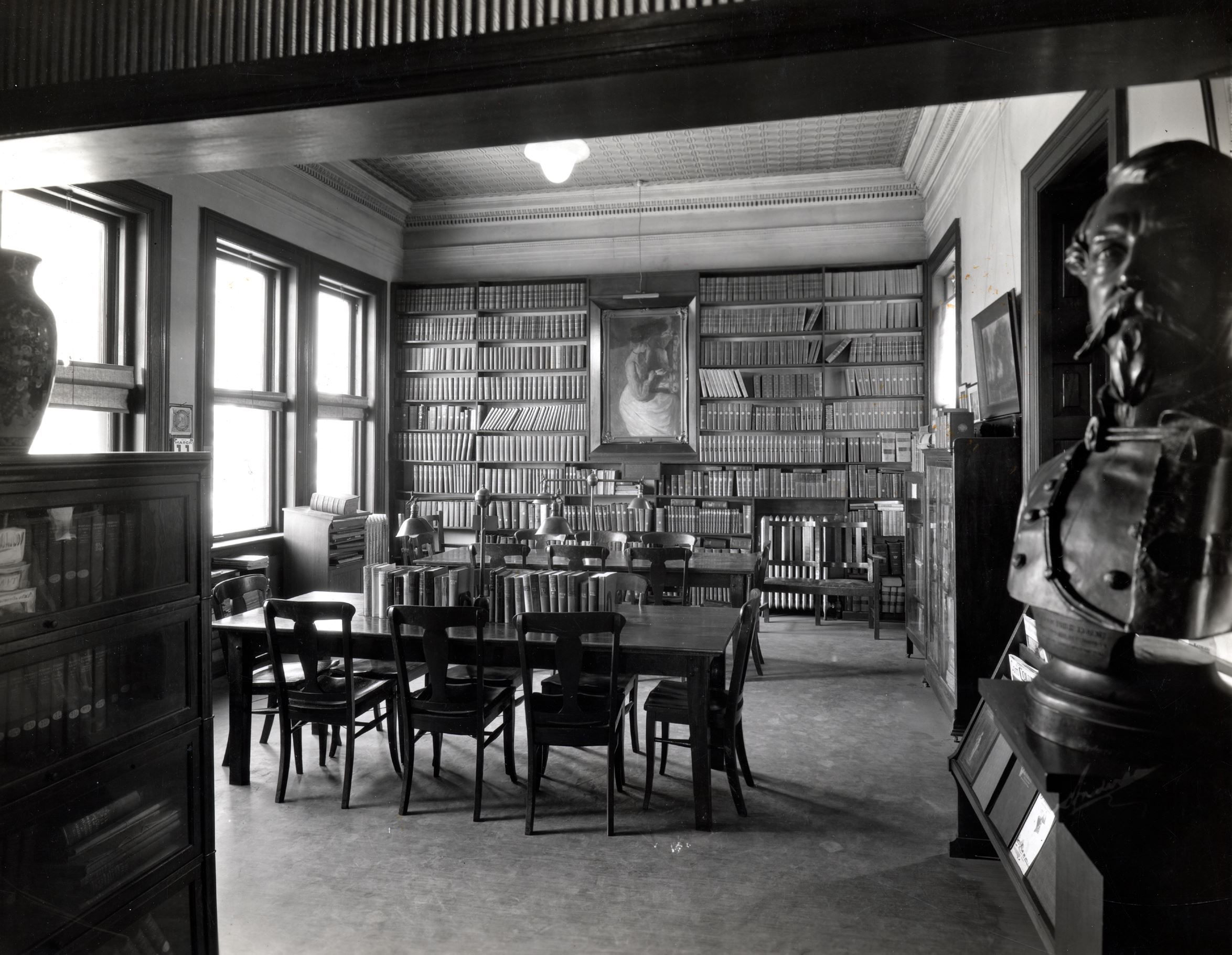 Mrs. Pauline (Augustus) Frank became the librarian in 1907. She is credited with cataloging the library's collection, and by her retirement in 1919 was acclaimed as, "the personal friend of almost every child in Kearney."
By 1909, the library's collection had increased to almost 8,000 books and the circulation for the year was 32,337. A New Era-Standard article commented, "Our library is inadequate in equipment to demands put on it."
The first four decades of the 1900s for Kearney probably could best be described as a period of slow but steady growth. The community gradually reached once again its boom time population of 10,000 of 1889. This description of slow but steady growth could apply equally to the growth of the library.
Even though the use of the library and the collection continued to increase during these years, it was not until 1939 that action was taken to enlarge the library's facilities. On May 11, a special meeting was held to discuss a Works Progress Administration project for a new west wing. By the end of the year, December 14, the new wing with a full basement was completed.
Use of the library's facilities and collection increased sharply when World War II brought about the opening of the Kearney Air Base. Until the end of the war in 1945, there were nearly 2,000 service members as active library patrons.